
'Disengagement is really dangerous'
Author and contemporary historian Louisa Lim on lessons from Hong Kong
To make sense of the sweeping political and social changes underway in the United States, it’s helpful to look to other places that have struggled with authoritarianism, as well as the erosion and loss of democratic systems.
Journalist, writer and academic Louisa Lim is one of the world’s best chroniclers of these power shifts, and especially of people’s lives under the controls of increasingly repressive regimes. Louisa was a longtime correspondent in China, first with the BBC then with National Public Radio (NPR), and is now an academic in Australia. (She’s also an old friend, we shared an office in Beijing.)
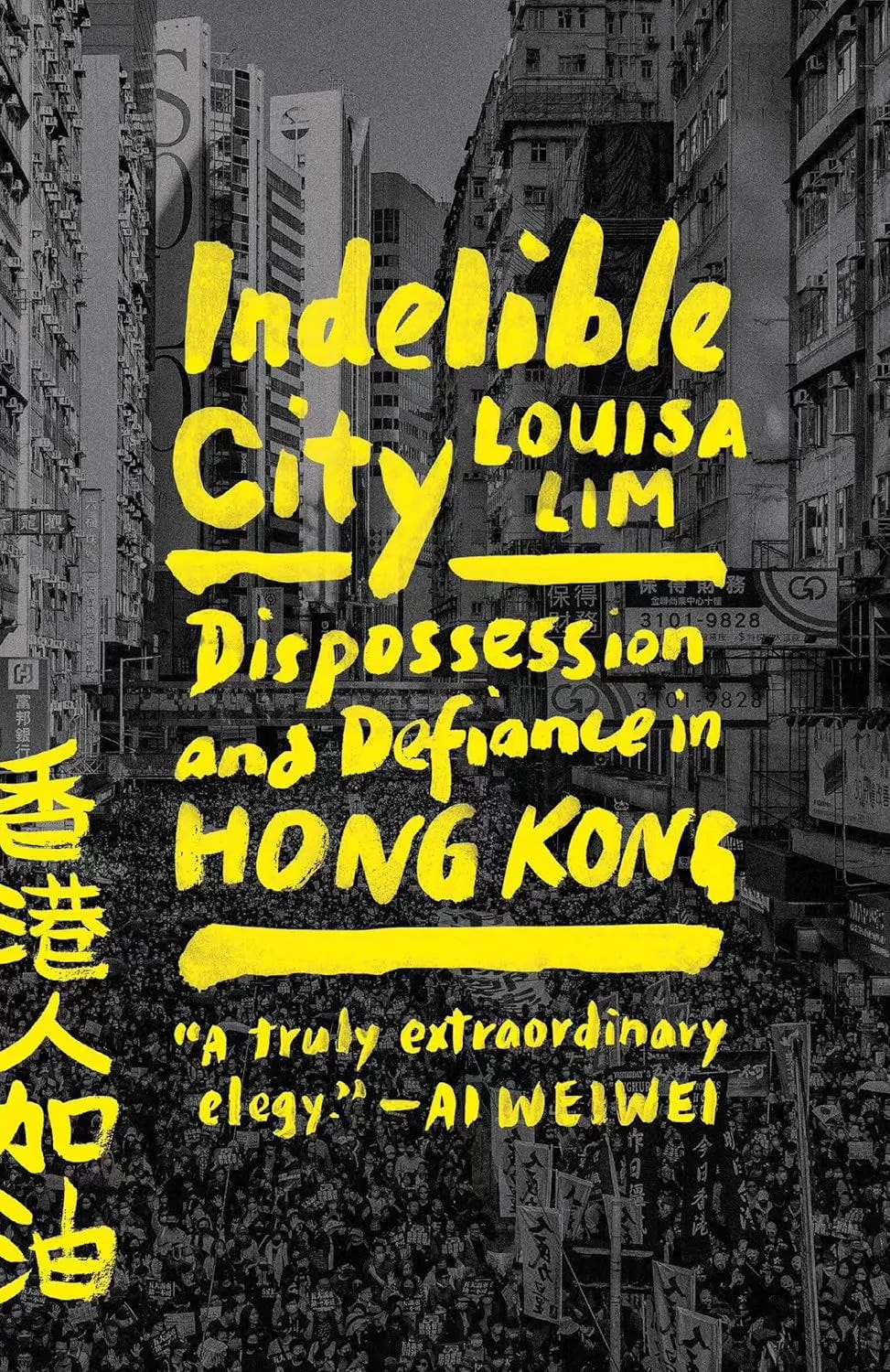
She’s the author of two excellent books that illuminate China’s moves toward tighter authoritarian controls. “The People’s Republic of Amnesia” explores the lasting legacy of the regime’s brutal crackdown on the Tiananmen Square protest movement in 1989. “Indelible City: Dispossession and Defiance in Hong Kong” reclaims the unique, and yes, defiant, history and identity of Hong Kong, her home city, in the moment the Chinese Communist Party works to erase it.
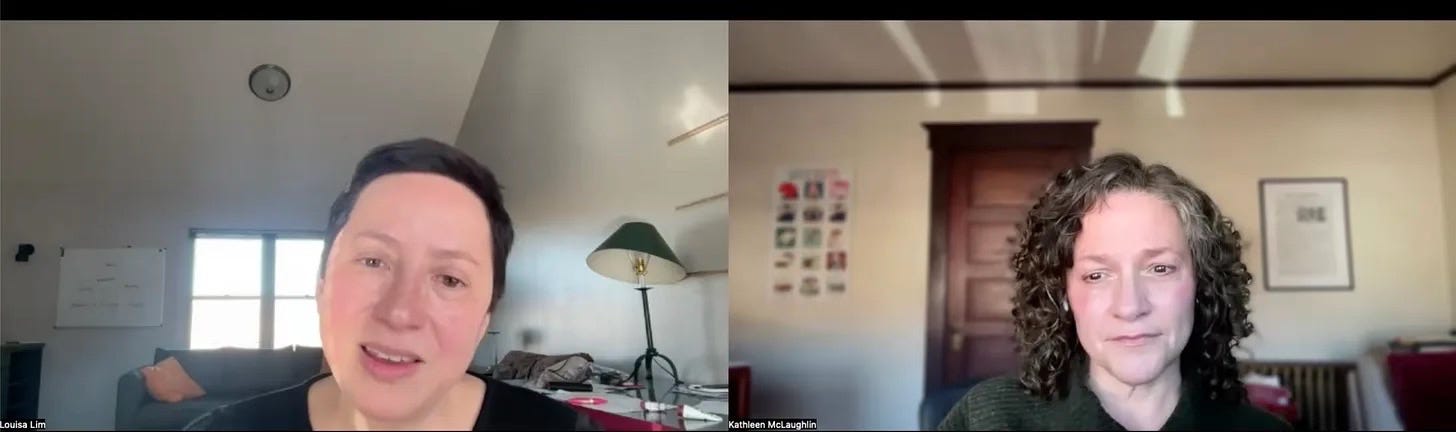
I spoke with Louisa about the US, where she taught for a few years after leaving China, and the fall of Hong Kong, which is not a perfect parallel to America. Nothing is. But there are important lessons about mass protest movements, community building and preserving the strength of independent media and civil society.
Just a few weeks ago, Hong Kong Media mogul and founder of the popular Apple Daily newspaper, Jimmy Lai, 78, was sentenced to 20 years in prison, the latest in a years-long campaign of repression of free expression as China has quashed the Hong Kong democracy movement. His is the strictest sentence yet handed down under China’s national security law, imposed on Hong Kong to suppress dissent.
A side note: Lai’s daughter, seeking to bring attention to her father’s case, will appear as the guest of Republican U.S. Speaker of the House Mike Johnson at the State of the Union address tonight, Feb. 24.
Lousia and I spoke over Zoom. This is an abridged text of our conversation, edited for clarity.
Kathleen McLaughlin: We are living in a moment of authoritarian escalation in the United States, including the suppression of free expression, freedom of the press, and many other rights Americans have long taken for granted. How do you see what’s happening in the U.S. in terms of parallels to the 2019 pro-democracy movement in Hong Kong and the suppression of Hong Kong by Beijing?
Louisa Lim: The immediate thing that strikes me as a parallel is just how quickly civil society was dismantled in Hong Kong. Even institutions with very strong and deep roots in civil society, newspapers, trade unions, media outlets, all kinds of organizations that had been going for decades, it was notable how quickly they folded and how shallow those roots turned out to be. And that’s something that made me think a lot about civil society and how and when it can be useful.
KM: Are you surprised to see it happen so quickly in the United States, after documenting and witnessing what happened in Hong Kong?
LL: I’m really surprised to see it happen in the U.S. I was surprised to see it happen in Hong Kong. I had never expected that kind of suppression to be so extremely effective and so very quick. Hong Kong’s situation is quite different from the U.S., because China was already in charge of Hong Kong when it happened, but I have been very surprised to see the way the trends are going in the U.S.

KM: What do you think brought Hong Kong people to the streets in incredible numbers, despite violence and threats, and what led them to continue protesting, perhaps well beyond what people might have expected? How did that movement continue to be so strong in the face of insurmountable odds?
LL: I think one of the factors behind the popularity of those protests is the education system in Hong Kong. Hong Kongers were very well-educated under a Western system of liberal education. It’s a small place as well. So we saw extraordinary numbers of people coming out into the streets. Out of a population of 7 million, it was estimated that 2 million people turned out to one march.
I think one reason was literacy and education. You’ve got a very literate, very news-hungry population and also very well-educated. Quite a lot of these schools in Hong Kong are run by various churches. There’s a level of religious belief and morality, belief in good and goodness that I think underpins some of the determination of people in coming out to the streets. I also think people were savvy about human rights. People have been very wary ever since 1997 when Hong Kong sovereignty returned to China. People have been looking for democratic erosion and rights being eroded.
You had a population that was both well-educated and primed to watch for these things. And then, once the protests started, I think people were under no illusions about what would happen.
I remember on the very first day of the very first march back in June 2019, there was this clip that was making the rounds, this young protester, a teenager, maybe, and he was asked by a reporter, “Do you think it will make any difference?” And he said, “No, but at least you have to try.” There was very much that sense. Even though it’s doomed, we need to show what this population is made of. There was this real feeling it was the end game. If you lose this time, everything is gone, civil liberties will be gone forever.
-Louisa Lim
KM: I’ve been thinking , as you’re talking about this, one of the things that we keep hearing in the U.S. is that if you can get a certain percentage of people out onto the streets, an authoritarian regime won’t survive. It’s a very small percentage (3.5 percent according to one theory). But that obviously wasn’t true in Hong Kong. What’s the lesson about protests that we can take from Hong Kong?
LL: If you think about the really big and successful protests, people always talk about People Power in the Philippines, but that was actually much smaller than Hong Kong’s protests. It’s hard to know what the lessons were, but one thing that was notable about Hong Kong was the decentralized nature of the protests. People used to call them leaderless protests, but there is a trend in academia to call it leader-full instead of leader-less. What does that mean? Leaderless makes it sound like it’s disorganized and, sort of messy and chaotic, but leader-full is where almost everybody was a leader in their own right.
People were taking on jobs according to their own ability. The graphic designers had set up an online cache of protest posters, and they were putting their posters in there every day. And then people were downloading posters, printing them out, putting them on their walls. People were taking initiative and taking on tasks according to their own professional skills. After the protests became violent, you could also see that in the way the opposition was organized. You would have people who did frontline work, really dangerous stuff, picking up tear gas canisters and throwing them back, or, putting them out, extinguishing them, and then you had people in the back who were doing other jobs. Although there was no official coordination, there was a lot of a lot of cooperation.
At a certain point the decentralization became a weakness because there was a lack of strategy. But I think it was an extraordinary level of solidarity.
KM: Let’s talk about freedom of the press. We just saw the prison sentencing of a prominent media figure in Hong Kong. Can you take us through how the undermining and suppression of freedom of press in Hong Kong played into the suppression of the territory.
LL: There was a long and patient strategy of encroaching control over the media, and a lot of that was stuff that the government did. It was private ownership. But over time, really, from the 1980’s onwards, newspapers were changing hands, and they were moving into the hands of businessmen or people with ties in China, or people who were more sympathetic to a Chinese perspective. So that was already in play. There was also a lot of self-censorship, and that stepped up after 1997.
There were editors or people in editorial positions who were put there because of their pro-Beijing sympathies, and you began to see a lot of self-censorship, where newspapers would run some stories and they wouldn’t run others. Once the protest started in Hong Kong (in 2019), it was particularly noticeable - the differences. For example, you would get better coverage online than you would get in the written papers, because there were different people in charge of the online versions. The printed versions underwent much more scrutiny.
There were a lot of reporters who were doing really interesting work, sending back amazing pictures, and that was going online, but not appearing in the print newspapers themselves. But then, of course, there was that idea of journalistic balance that every story would start with the government saying the protesters were rioters, saying they were out of control, this kind of thing, quoting police. The coverage was really biased against the protesters, and I think over time, those were the narratives that were seeded overseas.
And then there was a lot of money spent by China on social media, on producing these very slick videos of protesters doing bad things. I want to be clear here, there was a lot of violence. It went both ways. The protesters did do some very bad things. But I noticed afterwards that a lot of people I knew overseas weren’t talking about protesters in Hong Kong, they would use the word “rioter.” And that, to me, was a sign of the success of that strategy as well.
I think in Hong Kong, the national security legislation was the most important thing to bring the media under control.
KM: Can you explain when that came into play and what it did?
LL: (The National Security Law) was brought into play on June the 30th, 2020. The protests had been going on for some time at that point, and (the law) criminalized various offenses, including collusion with foreign forces and subversion. That was the tool that they used to shut down a lot of the media. The first big media organization to go was Apple Daily, which was the most prominent, most popular, pro-democracy newspaper.
The argument that the government used was that the chairman, Jimmy Lai, had colluded with foreign forces because he’d been on tours overseas and he was facing charges on other fronts as well. When they actually shut the paper down, they just froze its funding so it couldn’t operate, and then it was clear the paper would not survive. The day that its last copy came out, I think they sold a million copies. People got up really early to buy it because they knew it was the end.
And after that, overnight, its archive was wiped from the internet. It was just gone. Then what we saw was a lot of other smaller media organizations, some of them online only, but quite influential ones, more than a dozen closed themselves because they perceived that the risk was so high, because the national security legislation could be applied retroactively. Anything that they had online could be grounds for a lawsuit against them or a national security case against them. Then we saw a lot of other organizations shuttering themselves. In Hong Kong that’s been the way that a lot of civil society has been dismantled. It hasn’t been shut down, but people have shut their own organizations down because they perceive that it’s too dangerous.
KM: This is why they say self-censorship is the most powerful form of censorship, right? Just to follow up, Jimmy Lai was just sentenced to 20 years in prison. Did that sentence surprise you?
LL: It didn’t surprise me but it’s an extraordinarily long sentence. He is really being used to send a message. The message is, ‘we will take firm action against prominent people who are influential.’ Jimmy Lai is a businessman, first and foremost. He’s extremely rich. He could have left Hong Kong at any time. He was told, “you could leave,” but he did not. He stayed to face the sentence he was given, and the way that he’s been treated is extremely vindictive. He’s a very devout Catholic, and they refused to allow him to see a priest. It is, of course, a sentence that other journalists are looking at and it increases the climate of fear, and people’s worries about what you can and can’t say.
KM: We’ve been talking primarily about journalism. How has this chilling effect influenced other types of free expression, art, cinema, any other kinds of media. Have you seen that?
LL: There’s been so much censorship. It’s crazy. There have been art exhibitions that have been shut down, or exhibits that have been pulled, and film festivals. They’ve pulled huge numbers of films from film festivals, even the Hong Kong Academy of Performing Arts’ graduation play was canceled like the day before it was meant to happen, because it was perceived to be too political. There’s been a massive chilling effect, and it’s also very bad in universities. Certain academics, particularly people whose work involves Hong Kong identity or Hong Kong’s history, have been targeted. Inside the classroom, there is a real fear about what you can talk about and what you can’t. There have been these hotlines set up for people to report people who do acts that that violate national security. I think people in universities are really worried.
There’s a chilling effect throughout education. Textbooks are being rewritten. Courses are being pulled.
KM: Coming back to the US, when you look at the fall of Hong Kong compared with what we’re experiencing under Donald Trump, what advantages do you see for the survival of American democracy and conversely, what do you think our biggest disadvantages in this country are?
LL: Hong Kong was a very specific case. The fact that it had already been under Chinese rule since 1997 just means that Hong Kong is an outlier in any of these discussions. In the U.S., one advantage you have is the legal system, but given the composition of the Supreme Court, I’m not sure how much of an advantage that is.
We’re already seeing the erosion of liberties and judicial freedoms. We’re seeing people coming under a lot of pressure, lawyers and judges. In Hong Kong, one of the advantages was a highly educated population with a very high degree of solidarity. I think U.S. is very patchy, right? People have different education levels depending on where they live, where they grew up. And it’s also a huge disadvantage that the US is highly, highly polarized. It would be hard to imagine the kind of (protest) numbers that we saw in Hong Kong, that percentage of the population, in the US.
I would also say a disadvantage of the US, is some of the political class seems disengaged, and I think people have fatigue. People are saying, “I can’t read the news, I can’t watch the news. It’s too dreadful.” That disengagement is really dangerous.
KM: Do you have any advice for people on how to change that? Because it is overwhelming. I think most people are flooded with horrible news right now. How do you stay engaged?
LL: It might be that local organizing is important. Having local contacts. It’s impossible to be effective across everything but figuring out where your attention is best deployed.
The minute that people become disengaged it’s so much harder to change things.
I think there’s something about the atomization of society that is important. That was one thing that happened in Hong Kong; the minute national security legislation was imposed, they started to have these snitching lines where you could ring up and report people. People started getting really scared. Nobody trusted each other. It’s important to do activities that build local trust. We’ve probably already seen the atomization of society and solidarity (in America), just because there’s so much going on all at the same time, right?
KM: That’s an interesting point that I don’t think we see made very often people right now who are trying to push back against what happening or often speak about building community. But that we need to avoid this atomization of trust and build trust rather than have it disappear. You lived in China for a long time. You grew up in Hong Kong. You have been watching these things happen and reporting on them and writing about them for years. Do you think there is hope for us to survive this political moment intact, or have we already gone too far in the United States?
LL: I think the damage that is being done to American institutions is going to be extremely deep. It’s going to be lasting, and it’s much harder to build things back than to shut things down. A lot of institutions are going to be so gutted by what is happening. That’s going to be problematic.
Is there any chance to turn away from authoritarianism? I think when you’re already asking this question, it’s probably already too late.
This is the second in a series of conversations I’m having with smart folks about surviving the rise of authoritarianism in America. For the previous installment, check out my conversation with community organizer Garrett Bucks.
Up next in this series on Surviving America: A son of cult leaders talks about reckoning with MAGA and Americans’ propensity for cults.
I believe strongly that any conversation about the restriction of freedom of speech in the US can't start with the present moment. We have been encouraging and accepting the collapse of the freedom of speech for decades, in the name of conservative and progressive causes alike. What we're seeing now is a reaction to, and an extension of, a much longer-term trend. If we are going to speak up for the freedom of speech, we have to be prepared to put it above most if not all other values.