
The Westerners
A new book reveals a more complex and fascinating story of the American West
I’ve never been a fan of Yellowstone, the television series, which I have also never actually watched. I’ve heard - from many, many people - that it’s a great and ridiculous over-the-top soap opera, which is fine. I can’t stomach the violence (I tried, once, I swear), but living in the state that has become one of the main characters in that soap opera is overwhelming in countless annoying ways. Among those annoyances, I live in a town that was a film set for the series, which left its footprint here in fake storefronts and made-up signs, perpetuating the pretense of a past that never existed. Is that a cute new café? No, just a sign for a fake restaurant that Yellowstone left behind.
Too often the stories of the American West are told in this manner. Shallow portrayals of a region and people who are mostly white and male, wise cowboys and noble rubes, with a sprinkling of Indigenous people and women thrown in for color without depth. Sometimes these made-up stories are more sinister, as in the case of the Trump Administration’s use of Manifest Destiny and Western cowboy imagery to push anti-immigrant policies. Sometimes they’re just too bizarre to interpret, as in the case of billionaires dressing up like working-class cowboys and posing for photo shoots on lands they definitely don’t work themselves.
I am genuinely so sorry for the image that follows, but I just need to make the point that this moment in the history of the American West is embarrassing for us all.
The real history of the West, the one those of us who know it well are familiar with, is so much more layered and weird and compelling and messy. Did I mention weird? The deliberate flattening of our diverse, complex history into a clean aesthetic of white dudes in cowboy hats and boots is a dull, repetitive pattern. And yet the pattern persists.
So when I met the brilliant historian Megan Kate Nelson several week ago over dinner in Bozeman and learned about her new book, which is out in the world today, I knew I wanted to talk with her about it for this newsletter. Megan is an exceptional thinker and writer, and a fellow Westerner. Reading her latest book brought back some of my joy in learning the history of the region where I was born.
“The Westerners: Mythmaking and Belonging on the American Frontier” tells the history of the West through seven remarkable lives and stories, seven people who are not the stereotype. It is fun and fascinating, subverting myths at every turn, and provides a necessary retelling of the story of the West.
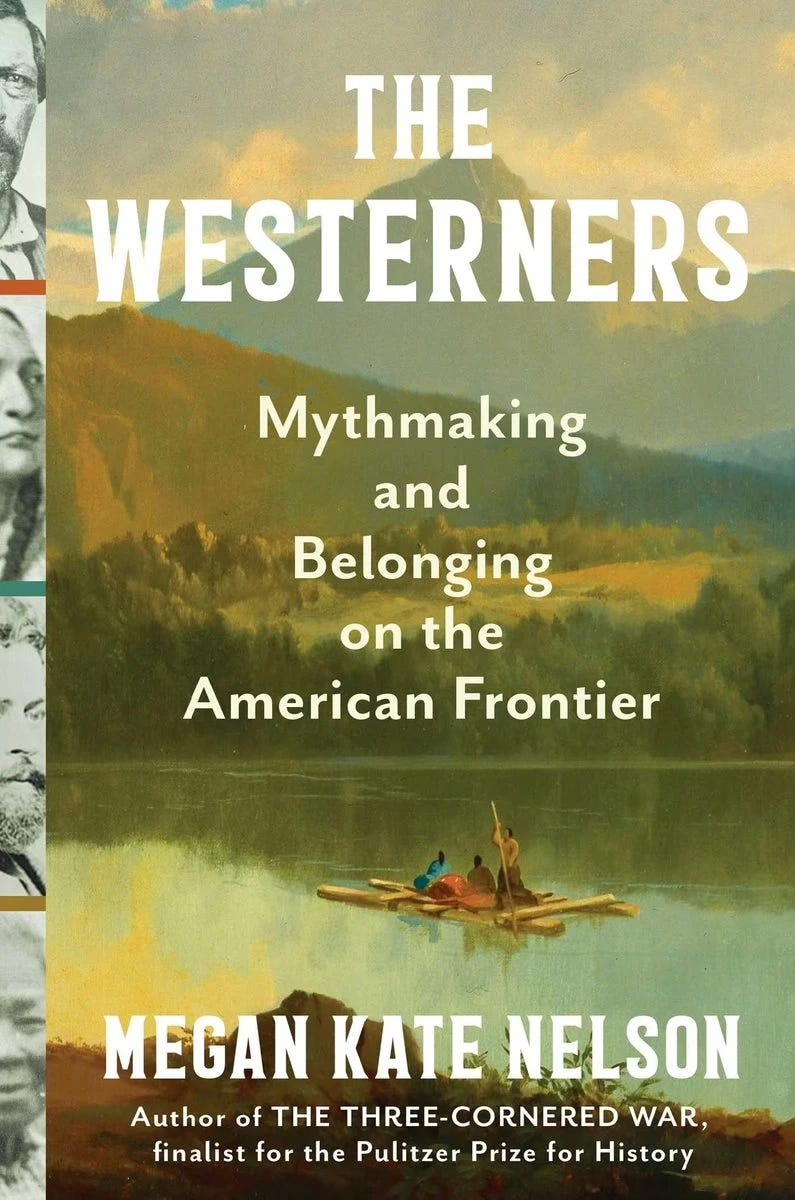
Our conversation follows
KM: You begin with a story of historian Fredrick Jackson Turner making a case to the public at the Chicago World’s Fair in 1893 that the American frontier is at the heart of American identity. As you describe it, that argument mostly fell flat to Turner’s audience but found appreciation from Theodore Roosevelt after it was published in a journal. Do you think Jackson’s argument about frontier and reinvention would resonate today? Have we evolved at all?
Megan Kate Nelson: Jackson’s arguments absolutely resonate today. You can see his primary point about pioneers creating the American character through their victories over Native Americans and nature in almost every modern Western, including an incredibly popular show like “Yellowstone,” along with popular trade history books, historic sites, and textbooks.
The simplicity of Turner’s arguments, their linearity (east to west), and the way they depict favorable traits like perseverance and adventurousness as uniquely American, and as an extension, uniquely white, are the reasons why the frontier myth has such enduring appeal for white Americans.
Academic historians have been trying to kill Turner’s thesis for more than 50 years, but the incredible work that they have produced has not made a dent in the popularity of the frontier myth. The American people as a population have clearly evolved, but the people in power (still mostly white men), have not. They are too invested in keeping their power (and they seem to think that if they share it, they lose it), and they locate that power in their whiteness and their masculinity.
You write: The frontier myth is a fantasy that white Americans have repeated over time to create a national community. It has, from the beginning, marginalized, ignored, or entirely erased the actual people who explored,fought over, excavated, and built the American West in the nineteenth century.
You also make a compelling case that this erasure is deliberate, and the work of many. Why was it important to you to tell a more complete story of the West?
MKN: I am a cultural historian, so the ways that Americans have constructed narratives about themselves and the extent to which these narratives do or do not reflect our shared realities and histories, has been of interest to me since graduate school. When I first started thinking about this project, I asked people who had lived much of their lives in the American West if they thought of themselves as Westerners. There were varied answers, but it was striking that those men and women who identified as BIPOC, did not identify as Westerners. As one of my friends put it, “I just never felt like that identity belonged to me.”
When I heard her say this, I knew that it was not enough to produce good research about the many communities who built the West in THE WESTERNERS. I needed to tell a more complete story, but I also had to show how being erased from the frontier myth affected these individual communities.
You’ve chosen seven real people - Sacajawea, Jim Beckwourth, María Gertrudis Barceló, Ovando Hollister, Little Wolf, Ella Watson, and Polly Bemis- to tell a new, deeper and more accurate and nuanced history of the American West and those who created and shaped it. Can you give some insight into why you chose these specific people to re-center the story of the West?
MKN: I chose protagonists for this book for several reasons:
They all had compelling personal stories that I felt would draw a reader into their lives
They each moved into and through the West in different directions
They overlapped a bit but not too much in terms of time period – so they enabled me to structure a chronological narrative that is biographically based
They were all extraordinary in that they left records behind or other people left records about them, so I could get pretty granular with the details
But they were also fairly representative members of their communities.
María Gertrudis Barceló, for example, was the wealthiest woman in New Mexico by the time U.S. troops arrived to occupy Santa Fe. But like all Mexican women, she lived her life in the context of national laws and gender roles (Mexican and then, American).
Little Wolf’s leadership of the exodus of his people from Indian Territory back to their homelands in 1878-79 was in fact extraordinary; but his actions tell us a lot about Northern Cheyenne culture, and about their resistance to the U.S. Army and federal power during this time period, which was a pivotal moment for Indigenous history in the U.S.
I deliberately chose four women because my previous books have been very dude-heavy, and I was tired of writing only about dudes (lol). I also wanted to re-center the story of the American West to focus on women of different races and ethnicities, who all had dreams and desires of their own. According to Westerns and many recent popular trade books on U.S. Western history, women could only really be the pious and domestic angel riding in the Conestoga wagon, or the sassy prostitute working in the frontier brothel.
It will not escape anyone’s notice that there is only one white man who traveled a linear path from East to West in this book – Ovando Hollister. Because there *were* tens of thousands of such Westerners. The book is not arguing that they did not exist. But even Hollister’s story is complicated, and he allowed me to talk about several elements of Western history that don’t get talked about a lot, in history or in popular culture: the Civil War, and Mormon control of Utah.
Among the Westerners you’ve investigated and written about in this book, Sacajawea might be the most well-known. What did you find out about her life that surprised you? What can we learn from her life?
MKN: ·The diversity and significance of Sacajawea’s work for the Corps of Discovery surprised me most. Lewis and Clark brought her on as a translator, but she also worked as a topographical guide, a dietician (she saved them from scurvy many times by foraging roots), a botanist, an ethnographer, and a diplomat. Her very presence with the Corps signaled to many Indigenous nations that they were not a war party, and she saved their lives in this way as well. By the time they reached the Pacific Ocean, and she demanded to be taken to the shore because she had come all that way, just like the others – I think she was thinking of herself as an explorer as well.
The fact that her trip with the Corps was just one moment in her life was also something new for me to consider. Like many American school kids, I learned about Sacajawea only in the context of the Lewis and Clark expedition. I knew nothing else about her, except that she went with them with Jean-Baptiste on her back. So, it was important to me to give readers a sense of who she was and what her life was like before she met them at the Knife River Villages, and after she returned. She lived as many Indigenous women did in that period: she was a farmer and a processor of bison hides; she was a mother and a wife (whose marriage was forced upon her, which was common as well); she was a war captive; and she was in nearly constant motion, even in a comparatively sedentary place like the Knife River Villages. I really do think she was one of the most well-traveled women in first half of the nineteenth century.
I also had not realized that Sacajawea was not particularly well-known in American history until the 1890s, when a new edition of the Lewis and Clark journals was published, and after suffragists embraced her as an icon for the work she did lobbying for a winter camp site and taking part in a vote on it in the fall of 1805. The first visual depiction of her did not appear until 1904.
We’re living in the “Yellowstone” era, a time when the West is still a caricature of a place and people for many Americans. What’s damaging about the current form of this mythologizing of the West? You speak to earlier erasures enabling the seizure of land. What’s the contemporary impact of perpetuating these myths and stereotypes of the West?
MKN:
· Destruction of national parks – Americans don’t need conservation or preservation! They just need development and resource extraction!
· Continued denial of Indigenous land rights, such as building the border wall through sacred Tohono O’odham lands in Arizona and pipelines that endanger land and water quality across Lakota lands in the Dakotas.
· Using western images to promote the deportation of immigrants from all over the world. It’s telling that the Trump Administration is using images of white pioneer families in Conestoga wagons, lone cowboys riding toward the mountains, and John Gast’s lithograph “American Progress” (1872) in PR campaigns for the Department of Homeland Security and recruitment posters for ICE.
· The Trad Wife thing – it is a rural image, but a specifically western one – women don’t need rights!
As a Westerner yourself, what’s your hope in working to change the narrative of the American West? What’s the best possible outcome of your work?
MKN: The frontier myth has proven itself an extraordinarily powerful narrative for more than two hundred years, so I am under no illusions that this one book will be final blow that brings the whole thing down. Although it would be amazing if it had that kind of impact!
But I am hopeful that readers will appreciate learning some things about the American West that maybe they had not known before and I hope they have an emotional connection to the protagonists in the book – these types of connection make it possible for people to rethink their assumptions and their biases. This is the power of stories in American life.
I hope that this book leads them to look at the kind of messaging the current Administration is putting out there and see it for what it actually is: a way to seize even more power over people who have worked to make lives for themselves in this country.
What are your top book recommendations for better understanding the real West?
· Beth Lew-Williams, John Doe Chinaman: A Forgotten History of Chinese Life Under American Racial Law. Harvard University Press, 2025.
· Virginia Schaarf, Twenty Thousand Roads: Women, Movement, and the West. University of California Press, 2003.
· Leo Killback, A Sacred People: Indigenous Governance, Traditional Leadership, and the Warriors of the Cheyenne Nation and A Sovereign People: Indigenous Nationhood, Traditional Law, and the Covenants of the Cheyenne Nation. Texas Tech University Press, 2019.
· Alaina Roberts, I’ve Been Here All the While: Black Freedom on Native Land. University of Pennsylvania Press, 2021.
· Deena González, Refusing the Favor: The Spanish-Mexican Women of Santa Fe, 1820-1880. Oxford University Press, 1999.
· And it’s a novel, but – Victor LaValle, Lone Women: A Novel. Penguin Random House, 2023. It’s not the real West exactly (it has some fantastical elements that I don’t want to give away) but it’s my favorite modern literary Western.
Oh, wow. I need to read this book! What a great post.
Thanks for this. Definitely will check it out. And hi!